Showing posts with label Space travel. Show all posts

Wednesday, September 24, 2025

Artemis II Boarding Pass

Next year, April 2026, NASA plans Artemis II crewed mission around the Moon. I have already my Boarding Pass :)


Thursday, April 3, 2025

Fram2 - First polar-orbit human spaceflight

Fram2 will be the first polar-orbit human spaceflight mission to explore Earth. It will launch into a 90° circular orbit to the south from Florida, making it the first human spaceflight to fly over Earth’s polar regions from low-Earth orbit.

The North and South Poles are invisible to astronauts on the International Space Station, as well as to all previous human spaceflight missions, except for the Apollo lunar missions but only from far away. To date, the highest inclination achieved by human spaceflight has been the Soviet Vostok 6 mission, at 65°. This new flight trajectory will unlock new possibilities for human spaceflight.

On April 3, UT20h33 I could make images of Fram2 using my Nikon D7500 camera. The spaceship was visible "near" the moon.


Sunday, July 21, 2024

Apollo and ISS Mission Control Centers

Visiting Nasa's Space Center in Houston with a tour at the Apollo Mission Control Center and ISS Mission Control Center

At the Apollo Mission Control Center - Replay of Apollo 11 landing

Live at the ISS Mission Control Center


Visit NASA Space Center Houston - Shuttle OV-095


Last april I visited NASA's Space Center in Houston. With my VIP ticket I could visit some really cool area's :

* Crew Systems Laboratory
* Shuttle Avionics Integration Laboratory
* Apollo Mission Control Center
* ISS Mission Control
* George W.S. Abbey Rocket Park Tour with one of the 3 remaining  Saturn V rocket.
 

At the SAIL OV-095 "Shuttle"

OV meaning Orbiter Vehicle; number started with a "0" never flew, started with a "1" did flew. OV 095 was a shuttle to understand how to build one and to test both hardware and flight software. A fantastic experience standing insite of the first ever structure of a space shuttle. 


Orginal Space Walk Glove ($50.000)

Original Shuttle Carrier NASA905

Falcon 9 First Stage


Monday, February 19, 2024

Boarding Pass Viper

Viper, Volatiles Investigating Polar Exploration Rover, will be NASA's first robotic Moon rover. This mobile robot will land at the South Pole of the Moon in late 2024 on a 100-day mission. The critical information it provides will teach us about the origin and distribution of water on the Moon and help determine how we can harvest the Moon's resources for future human space exploration.

My boarding pass is ready ...


Friday, January 26, 2024

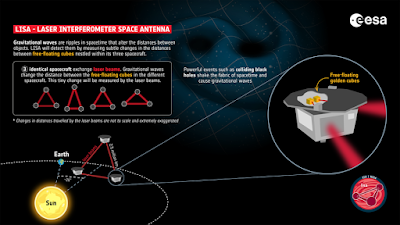
ESA LISA gets Go-Ahead


LISA or Laser Interferometer Space Antenna mission, the first scientific endeavour to detect and study gravitational waves from space is approved by ESA's Science Programme Committee. The mission is planned for 2035.

Read more via this link 


Sunday, January 7, 2024

Aditya L1: India's first Mission to the Sun arrived at L1


India's first Solar Mission Aditya-L1 succesfully entered into Lagrangian Point L1.At this point the solar explorer will orbit the sun about 177days.

The Aditya-L1 mission was launched in September and is carrying an array of instruments to measure and observe the sun's chromosphere and corona.

For more information see this link : https://www.isro.gov.in/Aditya_L1-MissionDetails.html

Friday, November 24, 2023

My name with Europa Clipper to Jupiter's Icy moon Europa


My name will fly on the Europa Clipper spacecraft as it travels 2.89 billion km on its voyage to Jupiter’s exploring the Icy moon.


Tuesday, November 29, 2022

US Postal James Webb Space Telescope Stamps


Today I received 20 stamps from the US Postal service. With the release of this vibrant stamp, the U.S. Postal Service celebrates NASA’s James Webb Space Telescope as it continues its epic mission to reveal the cosmos as never seen before.

“When anyone who uses these stamps looks at this telescope, I want them to see what I see — its incredible potential to reveal new and unexpected discoveries that help us understand the origins of the universe, and our place in it,” Robert D. Cabana, NASA associate administrator and former astronaut said. “This telescope is the largest international space science program in U.S. history, and I can’t wait to see the scientific breakthroughs it will enable in astronomy.”


Stamp Artwork

The image on the stamp is an artist’s digitally created depiction of the telescope against a dazzling starscape. Its 18 gold-coated mirror segments — hexagons that combine to form its 21-foot-wide primary mirror—can pick up faint heat waves representing the universe’s first accessible starlight from billions of light-years away. Opposite, supported by three struts, is the secondary mirror. Below are the telescope’s solar shield, computers, control machinery, and the solar array that provides power.

The words “Webb Space Telescope” appear in white along the bottom edge of the stamp. “USA/FOREVER” runs vertically up the left-hand edge. In the selvage, at top, “James Webb Space Telescope” is printed in gold against the darkness of space, with an image of a star in a gap between the title’s last two words. Additional stars and galaxies appear in the background. This image was taken to confirm the perfect alignment of the telescope’s mirrors.

Art director Derry Noyes was the designer for the stamp project using existing art by James Vaughan and an image provided by NASA and the Space Telescope Science Institute.

Saturday, November 26, 2022

BlueWalker 3 - Estimate Magnitude 1

Observing satellite BlueWalker together with SeaSat1. Estimating magnitute around 1. 

Satelliet BlueWalker 3 is a prototype satellite for AST & Science's SpaceMobile mobile communications constellation. The satellite will be to test AST & Science's patented technologies for connecting to cellphones in a space environment for their planned SpaceMobile constellation. The 1.5 ton satellite will deploy a 10 m diameter phased array antenna with 64 m2 area consisting of numerous identical sub-antenna modules to connect directly to standard mobile phones.
It is a prototype for the larger operational BlueBird satellites. The first five BlueBird satellites will be similar to BlueWalker 3, while the remaining will be larger.

Saturday, September 24, 2022

Neptune and James Webb Space Telescope

The James Webb Space Telescope captured Neptune together with it's rings. 


Webb’s Near-Infrared Camera (NIRCam) image of Neptune, taken on July 12, 2022, brings the planet’s rings into full focus for the first time in more than three decades.


The most prominent features of Neptune’s atmosphere in this image are a series of bright patches in the planet’s southern hemisphere that represent high-altitude methane-ice clouds. More subtly, a thin line of brightness circling the planet’s equator could be a visual signature of global atmospheric circulation that powers Neptune’s winds and storms. Additionally, for the first time, Webb has teased out a continuous band of high-latitude clouds surrounding a previously-known vortex at Neptune’s southern pole.

Saturday, September 10, 2022

Vega Rocket at the Milan Science and Technology Museum

VEGA (VV01) Credit Pascal Hilkens

The "Museo Nazionale Scienza E Technologia Leonardo Da Vinci" @ Milan houses a 1:1 scale model of the VEGA (VV01) rocket. The Museum houses the 1:1 scale model of the first Vega (VV01), a vector developed by the European Space Agency (ESA). About 30 meters high and with a mass of 137 tons, it is composed of 4 stages (3 solid fuel, 1 liquid fuel) that can transport and release satellites of up to 2.000 kilograms. Unlike most small launchers, it can carry multiple loads into Space, placing them on different orbits. Vega was developed thanks to a collaboration between Italy, France, Belgium, Spain, the Netherlands, Switzerland and Sweden. The first launch took place on February 13, 2012.

VEGA (VV01) Credit Pascal Hilkens

In May 2013, VEGA VV02 launched the Belgium made satellite Probe-V and in December 2015 VEGA VV06 launched LISA-Pathfinder.

Saturday, September 3, 2022

Monday, August 29, 2022

Artemis I launch scrubbed - earliest launch window september 2


Artemis I launch has been scrubbed. The earliest next launch window is expected to be september 2nd.

Friday, August 5, 2022

Space - The Human Quest @ Antwerp Expo


Untill October 16th 2022 you can visit the Space Expo - The Human Quest in Atwerp. I visited the expo last week. The tour took about 90min and I liked the anecdotes from Lieven Scheire. 


The expo gives a good historical overview of the space race between Russia and USA. There are some original pieces and 1:1 replica’s: Spoetnik, Vostok, Mercury, Apollo capsule, Moon Lander cockpit,... historical documents and objects: letter from Armstrong and personel object from our first Belgium astronauts Dirk Frimout and Frank de Winne. There are four "audio guides" to make it interesting for all ages.  


Interesting was also the Mars area explaining how the first Mars crew will "settle" on Mars. 


Tuesday, July 19, 2022

ISS July 17, 2022 (Tyrol Austria)


The International Space Station above Tyrol (Bichlbach Austria) on July 17, 2022 (UT21h26).
Setting: Nikon D7500 18mm f/3.5 ISO6400 with exposure time of 13s).

Wednesday, March 16, 2022

Dr Eugene Parker has passed away

On Tuesday March 15, Dr. Eugene N. Parker (94), visionary of heliophysics has passed away. In 2018, Dr. Parker became the first person to witness the launch of a spacecraft bearing his name, NASA’s Parker Solar Probe.

Tuesday, March 8, 2022