Showing posts with label Sunspot. Show all posts

Friday, December 5, 2025

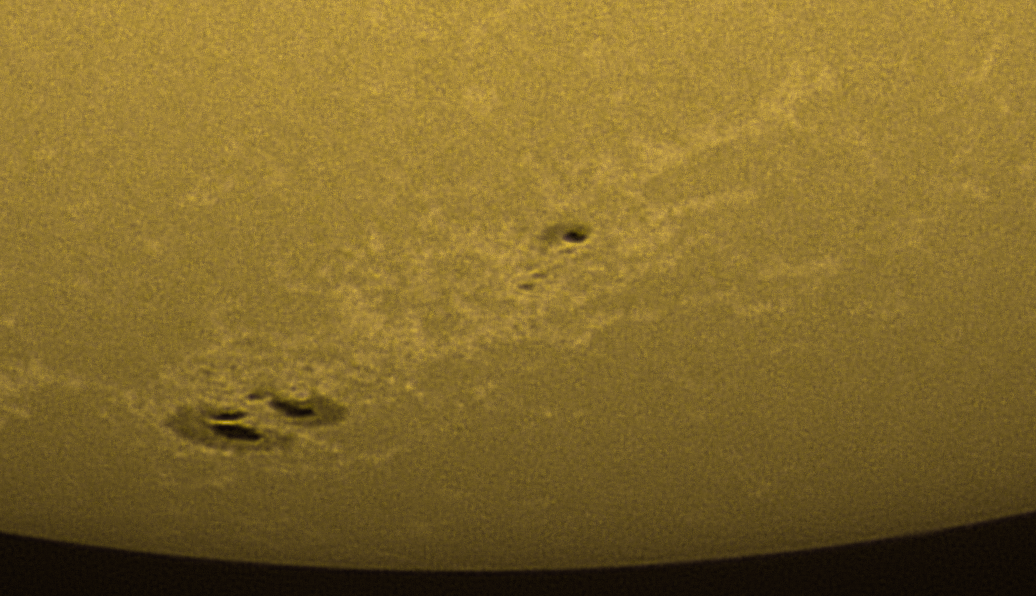
Sun AR4294 4296 4298

Clouds dissapeared for a short time, allowing me to photograph the Sun. Why? Beacuse of a couple of huge sunspots: AR4294, 4296 and 4298. Size are 1280MH, 650MH and 100MH. 

Setting:
TAL200K f/8.5, ASI290MM and Nikon D7500
ND3.8, OIII filter and IR/UV cut filter
Software: SharpCap, AstroSurface, CS4


Saturday, June 7, 2025

Sunspot AR4100 third tour AR4055 and 4079

Sunspot AR4100 made his third tour around the Sun. I made images of all the three tours of this Sunspot. At first this was sunspot AR4055 in the beginning of April, on May 1, it was sunspot AR4079 and by end of May it was Sunspot AR4100.


Thursday, May 1, 2025

Sunspot AR4079

Sunspot AR4079 was imaged this midday with good transparency and moderate seeing. The size is about 1070MH and thus visible with the naked eye (using an eclipse glasses ofcourse).

Setting: TAL200K, ASI290MM with barlow x2
Filters: ND3.8 solar filter, OIII and IR/UV cut filter
Software : Sharpcap, AstroSurface, CS4


Friday, April 4, 2025

Sunspot AR4048

Sunspot AR4048 on April 4, 2025.
Image with TAL200K f/8.5, barlow x2 and ASI290MM. Use of ND3.8, OIII and IR/UV cut filter.
Software: SharpCap, AstroSurface and CS4


Sunday, August 11, 2024

Sunspot AR3780

Sunspot AR3780, currently 1200MH big, was imaged this morning using:

TAL200K f/8.5 with ASI290MM
Filter: Solar filter ND3.8, OIII filter and IR/UV cut 
Software: Sharpcap, Astrosurface v1 Urania and CS4


Friday, June 28, 2024

My Solar images published in magazine Heelal


My images of sunspot AR3664 and the sun in H-alpha are published in astronomy magazine "Heelal" of July. Nice !

Sunday, May 26, 2024

Sunspots: what to see?

I used my picture of the huge sunspot AR3664 to point out what to see beyond the umbra and penumbra.


Friday, May 24, 2024

My picture of Sunspot 3664 on STCE website and newsletter 20240524

My picture of the very active Sunspot AR3664 taken on May 9th, is published on the Solar Terrestrial Centre of Excellence (STCE) website.


See also the newletter in pdf

Saturday, May 11, 2024

Sunspot AR3664 responsable for Aurora above Belgium

On May 10, I made some images of sunspot AR3664. This huge sunspot (2400MH) was very active with M and X flares. The resulting CME's are responsible for a fantastic live aurora show above Belgium and many other countries.

Setting:
SolarMax III 70/400 f/5.7 with ASI290MM
Reducer x0.5
Lights : Exposure time 0.675ms, 82 fps, 3000 frames
Use of flats. 
Software : SharpCap 4.1, AstroSurface, CS4  


Thursday, May 9, 2024

Big Sunspot AR3664 AR3668

Sunspot AR366/3668 is about 1200MH big and was also responsable for a flare X2.1 this morning. When lookng at the sunspot you will see a lot of details: umbra, penumbra, fibrils, umbraldots, lightbridges and granulation. It's one of my few pictures with such clear granulation.

Setting:
TAL200K f/8.5 with ASI290MM
Barlow x2
Filter: Solarfilter ND3.8, OIII filter and IR/UV cut filter
Exposuretime 1ms, 3000 frames, 81fps
Software: Sharpcap 4, AstroSurface, CS4


Sunday, January 28, 2024

Sunspot AR3559

Sunspot AR3559 with TAL200K f/8.5 and ASI290MM.

Image setting: ND3.8, OIII filter, IR/UV blocking filter
Image setting: ND3.8, Triple stacked Ca K baader 8nmfilter

Stacking: AS4! and editing using IMPPG, CS4, DeNoise AI


Combining both images together


Tuesday, December 26, 2023

Sunspots at the far side seen from Mars rover Perseverance


The Sun rotates on its axis once in about 27 days. This rotation can be seen by observing sunspots. This also means that Sunspots at the far side of the Sun can not be seen from Earth. With help from Helioseismology it's possible to create images of the far side and it's sunspots. Another interesting source is coming from Mars. The Mars rover Perseverance uses it's MastCam Z camera to take pictures of the Sun. Those pictures are not perfect but huge sunspots are visible and this can be interesting at the moment planet Mars is positioned towards the "far side" of the Sun.

For Mars Perseverance Images see this link.

I made a comparison between an image from the rover and the far side using helioseismology. The images are both made on December 22, 2023. We will see a week from now what it will bring.

Saturday, January 21, 2023

Sunspot AR3190

The huge sunspot AR3190 is about 710MH and visible with the naked eye. Through the thin clouds and with sunglass I was able to see the sunspot.


Sunspot AR3190 has a couple of lightbridges. 
The image was made using TAL200K f/8.5 and ASI290MM. 

Setting : ND3.8 solarfilter, OIII filter and IR/UV filter.
Software : SharpCap 4, AS3!, IMPPG, CS4


Saturday, November 12, 2022

Dynamic of Sunspot group AR3141 and AR3145

Picture of sunspot group AS3141 and AR3145 on November 11 and 12.


Sunspot AR3141 - CaK and White light


Sunspot AR3141, AR3140 and AR3145 observed on November 12, 2022. Sunspot AR3141 not only photographed in White Light but also with CaK filter.

Setting : TAL200K f/8.5, ND3.8 filter, CaK filter, ASI290mm, Barlow x2
Software : SharpCap4, AS3! (50% stacked), IMPPG, CS4


Friday, November 11, 2022

Sunspot AR3141 - Light Bridges


Some high clouds but still I was able to make some pictures of Sunspot AR3141 (and AR3140, AR3145). Sunpot AR3141 is a complex sunspot with an beta, gamma, delta configuration. 
The sunspot has also a couple of bright light bridges.

Setting: TAL200K f/8.5 with ASI290MM and ND3.8
Software: SharpCap 4.0, AS3! (25% stacked), IMPPG, DeNoise AI and CS4


Sunday, October 9, 2022

Sunspot AR3112 More Images


Images of Sunspot AR3112 on October 6th; above an overview of the sunspot region with different spots, below the p-sunspot AR3112.

Setting: TAL200K f/8.5, ASI290MM, Barlow x2, OIII filter, ND3.8 filter
Software: SharpCap4, AS3! (75% frames stacked), CS4, DeNoise AI


Sunspot AR3112 (OIII filter)


Image of Sunspot AR3112 on October 6,2022.

Setting: TAL200K f/8.5, ASI290MM, Barlow x2, OIII filter, ND3.8 filter
Software: SharpCap 4, AS3! (750frames), CS4, DeNoise AI


Sunday, September 25, 2022

55 Sunspots - 5 Sunspotgroups


Today the Sun was covered with 55 sunspots within 5 sunspotgroups. I made some pictures using my TAL200K f/8.5 with different set ups.

Setting: TAL200K f/8.5, ASI290MM, Barlow x2, light and CaK filter
Setting: TAL200K f/8.5, Nikon D7500
Software: SharpCap4, AS3!, IMPPG, CS4


Saturday, July 2, 2022

Cosmic rays and sunspot numbers Solar Cycle #25


I relooked into the data to see if the current increases sunspots of solar cycle (cycle #25) has a impact on decreased cosmic rays. The data I used was :

1) Sunspot data from Royal Observatory of Belgium, Brussels (WDC-SILCO-SIDC) with
2) Galactic Cosmic Rays data from University of Oulo, Finland

The data was plotted, starting from Jan 2009 till last month June 30, 2022. The graph is still showing an inverse correlation between solar minimum/maximum and cosmic radiation min/max.

see also my previous blog on this subject : link

The mechanism is believed that the sun during a less active period, the sun's magnetic field will be weaker with decreasing solar wind. This solar wind acts as a shield to protect Earth against high energetic cosmic rays. During solar minimum, those high energetic cosmic rays penetrate further into Earth's atmosphere resulting in more counts/s. This is what the Neutron Monitoring System of groundstation Oulu (Finland) detects.
The sources of high energetic cosmic rays (typically 5-30GeV) are from beyond our Solar System and even from outside our own milky way and thus Galactic and Intergalactic. For that we talk about (Inter)Galactic Cosmic Rays.